







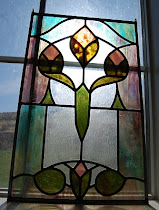


Hi glass friends, we really liked this tutorial on glass clay so much that we thought we'd share it with more people!
May 28, 2010

I’ve been asked often lately about making Glass Clay, so thought I’d give you a quick review: what it is and how I make it. I’m heading to Olympia next week to teach the Machine Embroiderers of Oregon and Washington how to make their own glass buttons with it. I’ve taught this technique nationally since 2004, at the Art Glass Association Conference in Portland Oregon. This is the first year in the last six that I did not teach Glass Clay (or Pate de Verre Without Molds) at the Las VegasGlass Craft & Bead Expo; I chose to offer a new class this year instead, while waiting to launch my new Medium. By ‘launch’ I mean all that a new product entails, including packaging, labeling and marketing. And after two years of research, it’s almost ready…almost!

Essentially Glass Clay is glass paste, another form of Pâte de Verre, but without having to make molds. Certainly not a traditional technique, but a fun, easy, fast way to make small glass sculptures, buttons, beads, and more!

I make a clay-like substance, glass paste, by mixing powdered glass with a liquid binder or medium. I prefer to use my new Glass Medium, which you will soon find on my website. After testing many different materials my new Medium burns out cleaner than anything I’ve ever tried, while still being able to carve more detail into it after it’s dry and before firing. Most people use CMC, and I’ve heard of and tested many other concoctions that may or may not work for you, but rather than go into them all I’m going to just tell you how I make it, using the best Medium I’ve ever tried.

I mix my Glass Medium with room temperature or warm tap water (if your water contains heavy mineral deposits, you can use distilled water, but it takes longer to set up…as long as a couple of days!): Fill a clean jar with a cup of water. Sprinkle in one teaspoon of Medium for a very thick paste.

Use a whisk or fork to stir until dissolved, then let stand 30 to 60 minutes to thicken, stirring occasionally. I like it to be the consistency of jelly. I have stored this new Medium in my studio for over two years after mixing, but typically it’s used up within a week. I have used other binders that developed mold and just so you know, the mold adds an interesting patina. If you prefer a less gelatinous mix, by all means thin it with a little more water. Also, if you’re planning to use it for liquid lines, you’ll want to dilute it.

Wearing a respirator or N95 disposable particulate mask, place your glass powderinto a mixing bowl. I prefer to use a small glass bowl, but often use a 4 or 8 ounce plastic food storage bowl. Ratios of glass powder to Medium vary, depending on the powder. Straight out of the jar glass powder can be as grainy as sand or as powdery as talc.

As a starting point I use 2:1, glass to Medium. I’ll place 2 heaping spoonfuls of glass powder into my bowl, then drizzle 1 heaping spoonful of Steider Studios Glass Medium over the powder.

Using a palette knife or spoon mix well, mashing the Medium into the glass powder until it’s glossy. It should be the consistency of cookie dough, or a wet pie crust, holding together when pinched or rolled into a ball. If it’s too dry, your project will crack; add more Medium a couple drops at a time. If it’s too wet, your project will sink down into itself; sprinkle more powder into the mix, a little at a time, mixing well after each addition.

Once it’s mixed to a consistency that feels like clay or cookie dough you’re ready to play. You have about 30 minutes working time to sculpt it, make pattern bars or press it into candy molds to freeze, then it begins to dry out.

I mix all my colors before beginning to sculpt, and wrap each with plastic wrap to keep it wet until I’m ready to work. I can store glass clay like this for weeks and have left it for up to a year. It can be a bit sticky, so I work on top of waxed paper to stay as mess-free as possible.

For sculpting I use dental tools, plastic and metal sculpting tools, plastic make-up applicators, toothpicks, kitchen implements and whatever happens to be close at hand.

I’ve made faces, flowers, animals, and small open vessels and bowls. These small sculptures can be used for door pulls, plant and garden decor, adornment for lidded boxes and much more.

You can press glass clay into candy molds, freeze for an hour or two, then pop it out of the molds. The advantage to using my Medium for this application (known as ‘freeze and fuse’), is you can ‘cold work’ the edges and carve in additional detail before firing, after the piece is completely dry.

One of my favorite ways of working with glass clay is making paste pattern bars. Have you played with polymer clay? Play dough? I use the same principles.

Roll it out (or roll it through a pasta machine) between sheets of waxed paper & stack layers of different colors, then slice, re-stack and slice again.

It’s easiest if you roll between two pieces of waxed paper because it can be sticky.

Make what I fondly call ‘Pig in a Blanket’ by making a rope, then wrapping it with a different colored ‘blanket’ that’s been rolled out flat. Or roll your pigs into many blankets for ‘rings’ of color when you slice.

Pattern bars are sliced with a tissue slicing blade, rolling the bar one quarter turn after each slice so you don’t end up with one flat side. Use these slices for buttons, beads, cabochons, or as decor for other glass projects just to give you a few ideas.

Make coils or ropes of clay, place different colored ropes next to each other for millefiore.
More food for thought: add mica! A little mica goes a long way. Adorn with Dicro Slide! Use a cute scrap-booking punch to cut shapes from Dicro Slide that enhance your design and apply just before firing.

To get a spiral effect, stack rolled out sections on top of each other.

Carefully peel off the wax paper, keeping it close to your work surface.

Then roll it up, smooth out and slice. The ends will be uneven unless you roll out rectangular shapes instead of ovals. I slice off the ends, roll them into balls, pushing the colors into a marbled pattern, then flatten them for buttons and cabs.

The next step is to let your projects dry on paper towels. Use a food dehydrator, or just set them aside for a few days. In a one day workshop we use hair dryers to speed the drying process. Once dry, glass clay is very fragile, like a meringue cookie so use care in handling it. Gently peel off the paper towel from the bottom. Using an emery board and wearing your respirator, file off any rough edges along the bottom. Use a wooden skewer to sand off any rough spots in your details. You can use a skewer or a dental tool to carve in additional lines if desired. Just remember to take care as it’s fragile. Did I already say it’s fragile? It’s very fragile!

When you’re ready to fire, try to fire like sizes and like colors together. For larger projects or light colors, your soak time will be slightly longer. I strongly recommend using a kiln that you can watch the progress so you’ll know when to stop and anneal, and you can note the process temperature in your kiln. Your pieces are going to shrink approximately 25 to 30%, depending on your process temperature. The longer you soak at process temperature, the glossier they’ll get and the more they’ll shrink. Vent your kiln until it reaches 1000º while the binder is burning out. You can ramp up AFAP, but I think it’s better to control the ramp up; and do start peeking around 1200º to 1250º. Be sure to wear your safety glasses when looking inside the heated kiln. In my kiln, depending on the size and color, my process temperature is 1300º with a 30 minute soak for small two to three-inch sculptures; or 1350º with a 13 minute soak for beads and buttons. I anneal at 900º, using Bullseye’s annealing_thick_slabs chart for thickness.

I love introducing people to working with glass powders, whether wet or dry. I hope you found this post useful and I hope you’ll try my new Medium. I have testers working with it now across the US and Canada, and am holding off my launch until all results are in. An instruction sheet, including complete firing schedules are included with each jar of Steider Studios Glass Medium. Available soon! Very soon, I hope!

If you’d like to be among the first to know the release date, you can subscribe to this blog by clicking the ‘e-mail subscribe button’ at the top right of this page; or click on my Facebook Business Page (then click on the ‘like’ button to receive updates), where the announcement will be made.

Have Fun! Be safe, wear that respirator and don’t forget your safety glasses!! Oh, and I’d be ever so grateful if you’ll tell your friends about Steider Studios Glass Medium!
EDIT: You can now purchase Steider Studios Glass Medium™ via Artfire……
Click here to purchase Steider Studios Glass Medium™ Economy Size on Artfire.Click here to purchase Steider Studios Glass Medium™ Regular Size on Artfire.
Click here to purchase Steider Studios Glass Medium ™ Sample Size on Artfire.


 Posts
Posts




2 comments:
I love this tutorial.you explain everything with great detail!
Thanks, Bubble My Licorice, for leaving this very kind comment. Unfortunately we can not take credit for this article! It was written by Steider Studios. Click on their links in this article to see their original page. We thought it was so informative that we shared it on our blog. The bottom of the article has links to their product Steider Studios Glass Medium, be sure to check it out.
Post a Comment