









We found this excellent tutorial on the blog Spawn of Flame and had to share it with more readers!
All material contained within this Tutorial is protected by Copyright, “Spawn of Flame” Rosemarie Hanus, 2009; all rights reserved.
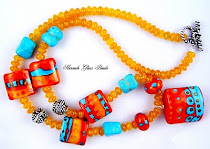
Rosemarie Hanus makes beads in her home studio. Almost all of them use Silvered Ivory Stringer – Look at these beads at Etsy, Art Fire, or her Spawn of Flame website.
This is a tutorial, not an expose! To say that I use a lot of Silvered Ivory Stringer (SIS) is a huge understatement, and I thought that I would show how I make my version of the stringer. It would give non lampworkers a look at one of our techniques, and it would give away my trade secrets to allow me to share with my fellow lampworkers.
What is SIS? I’m quoting Lori Greenberg as explained at Glass Arts on Craft Gossip:

Items used:
This tutorial also quite long, so I’m splitting it into several posts. For a teaser, here is how I prepare the silver foil.
First of all, notice that I use fine silver foil. It seems to give a better result, and it is easier to work with than fine silver leaf. I get one piece of foil and place it in the front of the foil booklet. I then cut it into 8 mostly equal pieces with my razor knife. I slice it in half, then I slice one side into halves and finally each of those quarters in half. I hold the foil with my other hand so that it does not bunch up. I just estimate where the cuts should be – that is close enough. With practice, it is easy to tell how much pressure to use to make a nice cut.

Next, I place a tiny amount of water onto my marver, with the water concentrated on the side away from me. The water holds the foil down so that it does not blow away or fold onto itself.

Finally, I put one piece of the foil onto the marver. I try to make sure that the edge of the foil closest to me is not on the water; I want that edge loose so that it will stick to the glass easier. If the edge is on the water, as it is in the photo, it just makes it a little harder to pick up the foil. Even more important, there needs to some room on the marver on the edge closest to me.

So now the foil is prepared.
Continuing the tutorial, here is another of my “secrets”. I use a clear core in my stringers. It gives me a little more control when applying the stringer (clear is more stiff than the ivory) and I think that it makes the ivory bubble more when finishing the bead. Besides, clears are notorious for having bad batches and it is a good way to use it up!What is SIS? I’m quoting Lori Greenberg as explained at Glass Arts on Craft Gossip:
It’s ivory glass, rolled in fine silver foil and then pulled into long glass strings (stringer). These stringer are used as an artist would use a pencil or paintbrush…to melt on fine designs. The reaction of the silver and ivory form a webbing and curdling effect that is both organic and mesmerizing.
Hidden Glade - Bead using Silvered Ivory Stringer
- Ivory Glass ( my go-to glass is Effetre Dark Ivory) – 1 rod
- Clear Glass (Vetrofond clear) – 2 rods
- Fine Silver Foil (this is important – Foil, not Leaf)
- Sharp Knife (such as Exacto brand)
- Graphite Marver
- Water
- Mashers
- Torch & flame!
- Prepare the foil
- Make an ivory plug
- Apply the silver leaf to the ivory
- Burnish the silver
- Heat
- Pull
This tutorial also quite long, so I’m splitting it into several posts. For a teaser, here is how I prepare the silver foil.
First of all, notice that I use fine silver foil. It seems to give a better result, and it is easier to work with than fine silver leaf. I get one piece of foil and place it in the front of the foil booklet. I then cut it into 8 mostly equal pieces with my razor knife. I slice it in half, then I slice one side into halves and finally each of those quarters in half. I hold the foil with my other hand so that it does not bunch up. I just estimate where the cuts should be – that is close enough. With practice, it is easy to tell how much pressure to use to make a nice cut.
Silver Foil cut by Razor Knife
Graphite Marver with Drop of Water
Graphite Marver with Fine Silver Foil
I should mention that if you are not used to pulling a large gather of glass that you should definitely wear a leather apron at the very least to protect yourself. I also will mention that it is your responsibility to take other normal studio safety precautions, including adequate ventilation. This process involves burning fine silver.
Notice that I use a thicker rod of clear – approx 6 mm. Sometimes I use smaller, but I like this size. Starting about3/4 inch (1.5 cm) from the end of the clear, I start wrapping the ivory around. The wrap thickness itself is pretty thick.

Wrap Ivory Glass onto Clear

Finished Ivory Wrap

Ivory Glass "Plug"

Tidying the Ivory Plug
I gently heat the plug, concentrating the heat near the outside. I try to keep the inside from getting warm or the plug will start to stretch out. This is not a good thing, because if it gets too long, the foil will not reach the end of the stringer. So, if it does get too hot, just tidy it up with the mashers again until it cools.
Ok, so now I finally have the outside of the plug hot, and the inside just right. Tip – I keep the mashers in my “not rolling” hand in preparation for the next steop. I place the plug onto my marver next to the foil. Doing it this way helps to assure the the end of the foil is attached.

Position Plug on Marver Next to Glass

Roll the Plug onto the Fine Silver

Use Mashers to Set the Fine Silver on the Plug

Burnish the Silver with Masher Edge

Silvered Ivory Plug Puntied with 2 Clear Rods
Now, I punty the second clear rod to the end of the plug. Just heat the end of the plug and the clear rod and push them together.
I promise – I will finish this Silvered Ivory Stringer Revealed tutorial in this post. (In case you missed it, part 1 is here, part 2 is here, and part 3 is here.)
Now, I heat the plug. I heat from the bottom – my rationale is this: the silver is going to burn off, and it might as well fume the ivory while that is happening. I really have no idea if this makes a difference, but that is what I do.

Heating the Plug
When I heat the plug, I always try and aim toward the center of the plug. It is hard to explain and the pictures don’t show it very well… But when I’m heating the right side of the plug, my right hand is closer to me, and when I’m heating the left side, my left hand is closer to me. The motion is sort of like steering a bicycle. When the glass starts to melt, my self talk changes the name of the plug to a gather; I’m sure that this makes all of the difference [said with a touch of sarcasm].

More Heat - Let's Call it a Gather Now!
When the gather is thoroughly heated, I bring it out of the flame, and wait. How long? Until it is ready. I know when it is ready, because I have made lots of them, and I just know. It is mushy and soft, but not runny – it also looks different; I have heard it described as “forming a skin”.
I often stand up at this point. If this gather drops, I do NOT want it on my lap.

Gather Out of the Heat - Wait!!!
Then I pull, just a little, and wait. It will begin to droop on its own. If I didn’t wait long enough in the last step and it starts to droop too fast, I blow on the punty ends. CAREFULLY! Burned lips are bad. Letting the center droop before pulling keeps the ends from being real thick and being like “dog bones”.

Pull the Gather Just a Little - Wait!
Once it stops drooping on its own, I start to pull harder and faster. The slower the pull at this point, the thicker the final stringer will be.

Pull a Little Faster
Finally, I pull firmly on the finished stringer. I wait 10 or 15 seconds at the very least to make sure that the stringer stays straight. See the nice lines on this twisty? Perfect! I finish by flame cutting it in the center and then trimming the stringer from the punties with my tile cutters.

Silvered Ivory Stringer


 Posts
Posts




No comments:
Post a Comment