







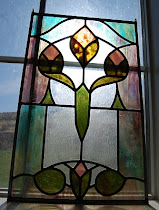


There are hundreds, probably thousands, of types of glass, with their different colors and textures, used in stained glass work. They all start out being one of the 2 basic types, cathedral or opalescent, then expand from there.
Cathedral glass is clear glass that you can see through. It comes in any color you could think of. It can have a texture on one side, or be smooth on both sides. It can be swirled or streaked with another color of cathedral glass.
Opalescent glass is glass that you can't see through. As with cathedral glass, opalescent glass comes in every color imaginable. It can have a texture on one side. It can be streaked or swirled with one or more colors of opalescent glass.
As you look through the examples below, you will see many variations of both cathedral and opalescent, some of them combining both types of glass in one single sheet of glass.
Each one of the types of glass you see below comes in a variety of colors, so don't think your only choice is the color shown.
At the end of this list I will give you the web site for each glass company so you can see all of the different types of glass each company makes.
Antique glass comes in several variations:
 Full Mouth Blown Antique applies to art glass produced by the historical mouth-blown cylinder method and relies on the craftsmanship of a master glassblower. The glass is blown into a cylinder shape which is annealed and cooled. The cylinder is then scored lengthwise, separated, re-heated and folded out into a flat sheet. Characteristics include attractive linear striations, and small round, sometime oval bubbles or seeds. These small bubbles (known as seeds) are one of the most important characteristics. Antique glass can be used in any piece you make. It makes beautiful flowers, nice backgrounds, entire panels. The only drawback is the price. It's expensive!
 Drawn Antique, also called semi-antique, machine antique or new antique, is a simulated full-antique. The textural striations are mechanically applied in these types of glass. Quality is excellent and cost is less than full antique. GNA (German New Antique) is a common example. Drawn Antique makes nice backgrounds and borders. Actually, it can be used anywhere in a panel. Make sure you cut it with the striations all going in the same direction.
3.Scribed Antique is simulated full antique introduced by Spectrum Glass in 1996 under the trade name Artíque®. The linear striations are scribed into the hot glass surface. Quality is excellent and cost is considerably less than full antique. Artique is used the same way as Drawn Antique.
Baroque™
 Baroque is an exclusive glass made by Spectrum. It is a machine made "reamy" glass, created by combining glasses of mis-matched compositions. The different glasses "oppose" each other when they are stirred together, creating artistic 3-D swirls. Baroque glass works well in almost all designs. It makes wonderful skies, water, flowers, just about anything you can think of. The clear baroque makes a beautiful background. You do have to work with the swirls when you cut the pieces, so that adjoining pieces of glass have the swirls connected at the right place. Otherwise, the panel look jumbled. Baroque is one of the types of glass that I love to use for backgrounds, especially where I need "movement".
Bevels

Bevels are usually clear, thick plate glass with edges that have been ground and polished to an angle other than 90 degrees. Transmitted light is refracted and a prism-like effect results. They come in many sizes and shapes as well as clusters or sets. The clusters or sets make up a design entirely of bevels that can be incorporated in a stained glass panel. Single bevels make beautiful exterior and internal borders.
Cathedral Glass

Cathedral Glass is transparent single color sheet glass, with smooth or textured surfaces. Cathedral is one of the types of glass that beginners find easy to cut.
Catspaw

Catspaw is a surface texture resulting from the chilling of hot glass on a cool table. The appearance is likened to the paw prints of a cat. Catspaw can be used as a feature in a panel. You wouldn't want to make the entire panel out of Catspaw, but it might work well for flowers, animals, grass...depending on the color mix you get.
Crackle
 Crackle glass is made like antique glass. The hot cylinder of glass is dipped in liquid, causing radical, random fissures in the glass. The cylinder is then reheated and further blown to heal the surface fissures. Resulting surface resembles the texture of alligator skin. Crackle Glass makes a nice background glass and it works well for borders. It is expensive compared to machine made stained glass.
Dichroic
 Dichroic is a glass that has been coated with one or more ultra-thin crystalline layers of transparent metal oxides. The oxides enhance reflections at specific wavelengths of light resulting in striking effects with a brilliant change of color as you move your head while you're looking at it. It's very expensive and is usually sold by the square inch instead of the standard square foot. Dichroic Glass is mainly used in jewelry making and fusing (in a kiln), but it also works well in contemporary patterns with just a little bit used throughout the panel to catch the viewers eye.
Drapery Glass
 Glass sheets with multiple dramatic folds, looking similar to folds in hanging drapes. Drapery Glass is a specialty glass, not used very often by the hobbyist, but I just wanted you to know about it. It's difficult to cut due to the huge variation in thickness. I've seen it used in contemporary designs giving a wonderful effect, and, of course, it can be used for flowing robes as seen in many church windows.
English Muffle

English Muffle is one of the types of glass produced by the Wissmach Glass Company. Originally popular in Victorian windows, English Muffle glass is being reintroduced in both restoration and contemporary stained glass work. English Muffle glass is known for its traditional muted colors, its highly refractive texture and crystalline quality. The texture appears as a non-directional ripple, allowing for minimal waste. English Muffle is one of my favorite glasses to work with. It's perfect for traditional and Victorian panels.
Fracture and Streamer
 This is one of the many unique types of glass manufactured by the Bullseye Glass Company. Thin glass chips or shards (fractures) and/or glass string (streamers) are arranged on the casting table before the glass is poured, and thus pressed into the glass sheet as it is formed. Fracture and Streamer glass makes a beautiful background for a floral theme panel, or if the panel is a scene, it works well to emulate flowers in the distance. It's also nice for a beautiful box.
Gluechip
 Gluechip is texture created on the surface of cold glass by applying hot animal glue and allowing it to dry under controlled temperature and humidity conditions. As the glue dries and contracts, it chips the glass surface in a natural and attractive pattern, likened to frost on a window pane. Glue chip glass makes nice borders, and the lighter colors make good background glass.
Iridescent
 Iridescent is a surface treatment in which a layer of metallic oxide is bonded to the hot glass surface just after sheet-forming, resulting in a colorful, shimmering effect. Many different glasses are available with an iridescent surface. Clear, textured iridescent glass is perfect for angel wings. Many iridized glasses work well for borders and accent pieces in a panel, and also make beautiful boxes and kaleidoscopes.
Jewels


A piece of glass that has been cut and faceted or press-molded into a geometric shape like a jewel. Jewels are often incorporated into stained glass projects.
Nuggets

Nuggets are also called glass gems or globs. They are a small, irregularly shaped "glob" of glass, flat on the bottom, rounded across the top. Nuggets are made by literally dropping a small amount of molten glass onto a flat surface. Like the jewels above, they are often incorporated into stained glass projects.
Opal or Opalescent
 Any glass which is opaque (you can't see through it). There are degrees of opacity, with some types of glass being a mix of cathedral and opaque, giving you a semi opaque. For instance, you could have an opaque white and a cathedral blue swirled together giving you a semi opaque streaky glass. Opalescent glass comes in one solid color or multi colored with a two, three and four color mix. If it is multi colored, no two pieces of glass will ever look exactly alike due to the way the colors are mixed after they come out of the furnace. Opalescent Glass glass can be used any way you can imagine. It's extremely versatile...trees, flowers, leaves, grass, sky, borders, lampshades, boxes, you name it.
Ring Mottle

Ring Mottle Glass is an opalescent glass in which rates of crystal growth have been controlled to create ring-shaped areas of opacity. The effect is a visual surface mottling. Ring Mottle is a glass that won't be used often, but you will occasionally see a place for it. It does makes nice flowers and leaves, and is beautiful in lampshades.
Seedy

Seedy Glass is glass in which air bubbles are entrapped. Air or gas is injected into the molten glass prior to forming the sheet. Seedy glass makes a good background and border glass. This is one of the types of glass that takes some getting used to when you cut it.
Streaky Glass

Streaky Glass is two or more cathedral glasses mixed together to create a multi-colored glass sheet. Some use this term also to describe Mixed Opalescent glass as described above. Streaky Glass can be used the same way opalescent glass is used (above).
Textured Glass

 Textured Glass is made by rolling and embossed roller over the hot glass after it's been poured on the table. One of the forming rolls is embossed with a texture that is imprinted on the glass as the sheet is formed. This produces glass smooth on one side and textured on the other. Some of these types of glass are "hammered," "granite," and "muffle." Textured glasses make great backgrounds, borders, geometric shapes such as diamonds. One of my designs has 5 trees in it, and I used textured glass, in large pieces, to give the appearance of leaves on the trees.
Waterglass

Waterglass is made by Spectrum Glass exclusively. The surface texture is created by stretching the hot glass sheet while it is still in a malleable state. The result is gentle, rolling waves that resemble the surface of a lake, stream, sky or grass. The pale colors make beautiful background glass.
Wispy

Wispy Glass is a Spectrum Glass innovation. Mixed opalescent glass with only thin wisps of white, like lazy cloud trails. Wispy glass works well for flowers, leaves, clothing such as a fairy's dress, boxes...the more you work with it, the more uses you'll find for it.
The following links will take you to various glass manufacturer's web sites. Each one will open to their glass sample page so you can see the types of glass they make. You'll also find links to virtual tours of some of their factories giving you the opportunity to see how glass is actually made.
Armstrong Glass Company
Bullseye Glass Co.
Profusion Glass (Dichroic Glass)
Lambert Antique Glass This site is from Germany and is written in German. Click on "Produkte", then "Mundgeblasene Flachglaser", then click on each one of the drop down boxes, to the right, to see the types of glass they make. If you have the time and feel inclined to watch, here's a 9 minute video from Lamberts that goes into detail about making antique glass.Making Antique Glass
Kokomo Opalescent Glass and Take a Tour of the Factory
Spectrum Glass Company and here you can take a Virtual Tour of how they make their glass.
Youghiogheny Glass and a Tour of their glass making facility.
The Paul Wissmach Glass Mfgs
Chicago Art Glass
Uroboros Glass
I hope you have enjoy learning about the different types of glass used in stained glass work. This isn't a complete list, but it covers the majority of glass used most frequently. As you will notice when you look at the manufacturer's web site, each company has some of their own unique glass types that aren't made by any other company. You'll also see textures that I didn't mention above. There are so many different textures, it would take an entire page to list them all.
Use the manufacturer's web sites to choose colors when you're ready to work on a project. Then when you want to buy the glass, you'll have a good idea of the colors you want. You might not find the exact brand and color code, but you will be able to find something similar. Every stained glass shop does not carry all of the brands and their respective colors. That would be an enormous inventory for any business.
Whenever possible, shop for your glass locally. It's much easier to pick it out by looking at the exact piece rather than ordering online where you might get a piece with a color mix you don't like, or the streaks going in many directions when you wanted them going one way only.
I'm definitely not against ordering stained glass supplies online ...I do it frequently. However, whenever possible, I buy my glass locally, or go to my wholesaler and look at the glass, so I can choose the types of glass that are exactly what I want. If I need to order glass I don't order it online. I actually call the business and talk to them about what I need. I've had great service from Delphi Glass, with them sometimes actually going to the warehouse to describe swirls, streaks, etc to make sure I get exactly what I need.
Lastly, when you buy glass, be sure to ask for the manufacturer's name and the color code for the glass. Write it down and keep it in a safe place. You never know when you might want another piece, and just describing the glass to the lady in the stained glass shop might draw a blank stare!


 Posts
Posts




No comments:
Post a Comment