










Devitrification, a whitish scum that sometimes appears on the top surface of glass that has been fired in the kiln, occurs when glass remains at too high a temperature for too long. In most cases, devitrification is considered a nuisance, and glass artists will go to great length to prevent its formation.
To understand why devitrification forms, we must first understand the nature of glass at room temperature. Although a sheet of glass appears quite stable and unchanging, it's actually delicately balanced between two states of being. On the one hand, there is an equilibrium in the glass between its various constituents (sand, soda ash, limestone, etc.). On the other hand, a tension exists as these individual components (especially the sand) have a natural tendency to return to their original states.
When glass is heated, this equilibrium is interrupted. The particles of the glass are heated past their solid state and become increasingly liquid. So long as the glass is allowed to return to its solid form fairly quickly, the molecules are able to return to the normal configuration and the delicate balance is restored.
However, if glass remains at too high a temperature for too long, then the normal process of establishing equilibrium is interrupted and the molecules in the glass are prevented from regaining their delicate balance. Instead, the high temperature causes some of the elements in the glass to burn off. The glass crystallizes along the top surface, forming a crystal (called devitrite). A mild case of devitrification results in a dull whitish deposit on the glass, while more severe cases can cause the top surface to break down and even deteriorate completely.
How to make your own DEVIT SPRAY (Borax/water solution)
How to use: Spray or brush lightly on top surface of glass prior to slump firing.
Ingredients: 1 teaspoon borax to one cup water. Distilled water works best. Regular borax cleaning powder (such as the "20 Mule Team brand" in the US) works well. Precise measurement not required.
Safety precautions: Don't drink. Wash hands after using. Long term exposure to borax can be harmful.
How to make: Just mix the borax with the water. If you put the two ingredients in a small glass jar with a lid, then cover and shake, you'll be assured of a good mixture and have a place to store the solution, too. Label the jar. Shake again prior to each use.
Note: We use the Borax mixture when fusing in our own kilns at Harrach Stained Glass. Now, we do not use distilled water since that would mean an occasional trip to the grocery store which is out of the way. (We just use tap water.) What we like to do is apply the Borax mixture, by hand to certain glass pieces and with a paint brush on more delicate pieces that have many design elements. Originally we only sprayed the Borax mixture on the glass and tried fusing, but by doing it that way we ended up with permanent water marked stains on our blue and clear glass pieces. Later, on another project, we discovered that the spray bottle was clogged, probably with Borax particles from the bottom of our spray bottle. At that point we decided to pour a small amount of the homemade devit mixture onto the piece we were going to fire and then spread it by "hand" using just our fingers. This actually resulted in a perfect finish on the completed project with no devit and no fingerprints!
We have learned to never shake up or mix the Borax mixture that you have made right before applying. You will notice that the Borax and water seem to separate and the Borax will fall to the bottom of your container. We use the "top" water from our mixture to use as our devit "spray". Of course eventually your mixture will run low and you will need to make some more devit "spray". When you make it, shake it up well and then let it stand a while so that the heavier Borax particles will fall to the bottom of your container before you apply to your piece.
The Borax mixture has been good on difficult colors and fired at up to 1475 degrees with excellent results.


 Posts
Posts




3 comments:
For the info on the spray. Do you put it into the kiln wet or damp or let it dry completely? Thanks for all your help.
I let it dry so it doesn't puddle anywhere or stick on shelf paper or kiln wash. Make sure it is thin and doesn't have any clumps since the clumps can sometimes leave bumps on the glass.
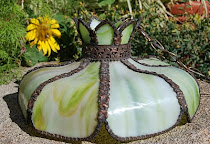
Thanks for the borax tip. Firing a sample now. It's for an opalescent slumped piece of glass for a lamp. I threw a sample of the glass in the kiln the other day and it devitrified badly. It was, however, on a piece of kiln paper. Firing the current sample on an old slump mold. We'll see what happens! If it works you're my new best friend!
Post a Comment