





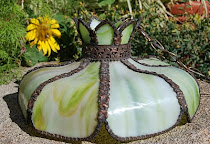





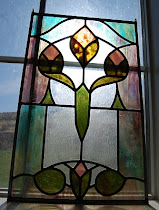


This article, written about both leaded glass and faceted glass windows, has a lot of information for both stained glass artists and what to look for - for potential customers!
Stained glass is a general term covering all forms of
glass used in a decorative manner, primarily for windows,
but also for a myriad of secular uses prevalent today.
In as much as the stained glass craft is an adjunct of
architecture, this Association favors the principle of
architectural direction in the selection of artisans or studios
and the commissioning of stained glass projects.
Products of SGAA artisans are ideas and concepts
that are translated into site-specific designs satisfying the
requirements of the project, budget and schedule. We
believe that project success is better assured when a studio
is selected not on the basis of a “square foot” bid but
rather by virtue of artistic ability, imagination, past success
and, of course, willingness to work within the project
constraints of time and money. Consultation and design progress
review with the architect, client and artisan
should take place before construction documents are
complete. Early and regular review sessions are welcome;
such will save time and prevent the needless cost of
design adjustment.
Therefore, we believe that ideal conditions fostering
mutual confidence and the best practical procedure will
prevail when only one craftsman studies the problem
with the architect and client. Should such a craftsman fail
to provide a satisfactory solution, we believe that he
should withdraw, thus permitting another craftsman to
fully cooperate with the client.
If the prospective client wishes proposals from more
than one craftsman, we earnestly recommend the following
procedure:
1. A personal discussion is held with each craftsman
invited that determines the client’s likes and dislikes,
and to arrive at a general theme and style. If a special
sketch is required, the artist will then be able to create
the appropriate design.
2. The client makes known any budget restrictions. Any
one of our members will gladly assist in setting up a
practical budget.
3. The names of the craftsmen invited to make proposals
are made known to all concerned.
Consultation between architect, client and craftsman
should begin before contract documents are finalized.
Early cooperation will assure a well-integrated
design that considers all architectural, structural and
interior building elements.
Historically, SGAA artisans prefer that their agreement
be directly with the client, fully separated from the
general contract; however, all are vitally concerned with
the full satisfaction of the client and can adapt their
process to fit the project.
Leaded Stained Glass
The Process: The preparatory sketch is translated
into full-size mechanical drawings (cartoons) and further
into actual patterns to be used to cut the glass. Once the
patterns have been prepared and assigned color, the glass
is cut into the myriad pieces required to build the window.
When the design requires detail painting or ornamentation
of the glass surface, it must be done with pigments
designed specifically for stained glass. Once
applied, the pigment is fired in a kiln to the proper temperature
for the respective pigment, usually between
1000 and 1250 degrees Fahrenheit, thus assuring absolute
permanency. The pieces of glass are joined together with
lead came (H-shaped strips) and soldered at their intersections
on both interior and exterior surfaces of the
assembled panel of stained glass. Varying widths of lead
came are often used to add to the window’s decorative
effect as well as enhance its strength.
To prevent leakage, a mastic waterproofing material
is inserted between the glass and the flange of the lead
came. This process, often called “cementing,” is required
on both interior and exterior surfaces of the panel and is
paramount in weatherproofing as well as stiffening the
panel. It is recommended that panels be stored on a flat
surface for a minimum of two weeks prior to installation,
thereby allowing them to properly cure.
Reinforcing bars, regardless of the type, are typically
fastened or mechanically engaged at regular horizontal
intervals to the frame, sash or other substrate into which
the panel is installed. These surface-applied bars further
strengthen and support the installed panel of leaded
stained glass. Round bars usually measuring 3⁄8 inch in
diameter, tied to the panels with twisted copper wires, are
the most flexible and resilient, and therefore allow for the
greatest amounts of thermal movement. Where this system
is not suitable, galvanized-steel flat bars can be soldered
directly to the surface of the leaded glass panel.
Installation: It is recommended that leaded glass be
installed into frames designed specifically for that purpose.
Various types can be considered and include wood,
aluminum, steel, bronze and stone. Regardless of the type,
the most important consideration is that they are capable
of supporting the unique qualities of the type of stained
glass that is being installed. When possible, glazing beads
should be used in conjunction with modern, flexible
sealant systems to allow for flexibility as well as mechanical
engagement of the installed panels of glass.
The stained glass studio should be consulted as to the
best type of frame for the project at hand, the location
and placement of division bars, and mullion configuration
that will work best with the intended design. This
information should be finalized prior to ordering the
window frames or sash (usually supplied by the general
contractor on a new building) into which the stained
glass will be installed.
In general, the type of frame selected needs to be
capable of supporting stained glass weighing approximately
four pounds per square foot and configured with
mullions, allowing sub-division of larger areas into panels
of approximately 14 linear perimeter feet. In addition to
the overall structural requirements, the frames or sash
must include a glazing rebate that measures 3⁄8" to 1⁄2" wide
by 3⁄8" to 1⁄2" deep and allows the panels of stained glass to
engage into the frame or sash a minimum of 1⁄4". An
allowance of 3⁄32" to 1⁄8" between the stained glass panel and
Glazing Sealant: It is highly recommended that all
sealant be of the non-acetic gas-forming or neutral-cure
variety and that it be chosen based on the composition of
the materials and substrates to be sealed. Appropriate
bond-breaking tape and ethafoam backer rod should be
www.stainedglass.org www.SGAAOnline.com 3
used as required to achieve the flexibility necessary for
expansion and contraction of the finished installation.
Faceted Stained Glass
(Dalle de Verre)
Process: A twentieth-century innovation in the art
of stained glass introduced the use of glass dalles measuring
approximately 8" x 12" x 1". These dalles, cast in hundreds
of colors, can be cut into shapes and used, in combination
with an opaque matrix of epoxy resin 5⁄8" to 7⁄8" in
thickness, to create translucent windows and walls of
great beauty.
The epoxy used in the casting of faceted glass panels
must be a specially formulated slab-glass-setting compound
consisting of epoxy resin and hardener. The material
must be able to withstand temperatures of +130
degrees Fahrenheit on the exterior surface and a simultaneous
+70 degrees Fahrenheit interior surface (air conditioned),
and allow for humidity changes of 6% to 100%. In
addition, cast panels must be water resistant on tests of
25 lbs. per square foot static air pressure while 21⁄2 gallons
of water pass over the surface of the panel for one hour.
The design and physical opening size determine size
limitations. However, individual panels should not
exceed 16 square feet. The height to width of a single
panel should not exceed a 4:1 ratio. Large openings must
have horizontal supports to carry the weight of the
stacked panels. Thickness of the epoxy matrix should not
be less than 5⁄8" for unstacked panels. When they are to be
stacked, a minimum epoxy thickness of 3⁄4" is recommended,
with the joints between the panels sealed with a flexible
glazing sealant.
Installation: Faceted glass can be installed in openings
and mullions of masonry, metal or wood, provided
that the system is designed to receive the thicker panels
and carry the load of approximately 10 to 13 pounds per
square foot. The stained glass studio should be consulted
well in advance of finalizing the contract documents for
the appropriate frame type for the project and location of
any division bars and mullions, so as to coordinate them
with the design before ordering frames or sash.
Clearance of 3⁄16" is recommended between the frame
or substrate and panel edge to allow for proper expansion
and contraction of the completed panel. Neoprene spacers
(durometer 40 to 70) can be used as needed to insure
proper clearance.
Glazing Sealant: Faceted glass panels should be set
into a non-hardening material such as butyl, acrylic, silicone
or polysulphide sealant, which should be used both
as a bedding and finish bead. This will provide a weather tight
seal between the faceted glass panel and the frame or
substrate into which the panel is installed. For spaces of
more than 1⁄4" between the substrate and the panel, filler
such as ethafoam is recommended under the sealant bead
to allow for flexibility.
Protective Glazing
Exterior Protective Glazing: Properly made and
installed leaded, stained and faceted glass does not require
exterior protective glazing to make it waterproof; however,
if properly installed in conjunction with stained or leaded
glass, protective glazing may afford some protection against
vandalism and external damage. Because of its high resistance
to breakage, faceted glass does not need protective
glazing. If protective glazing is to be included as part of the
project, it must be decided early in the building program so
that proper framing and installation details can be developed
to eliminate many of the negative effects normally
associated with its installation.
Clear, laminated safety glass and tempered glass are
superior to acrylic or polycarbonate plastics as protective
glazing. The plastics craze and yellow in relatively short
periods of time, while glass remains clear, preserving a clean
appearance to the building exterior.
Current research dictates that protective glazing be
vented, thereby alleviating the possibility of excessive heat
buildup and the trapping of condensation. The specific
method of venting this enclosed space varies from installation
to installation due to many diverse conditions, ranging
from the type of frame system being used to the climatic
conditions and micro environment of the building. Before
considering the inclusion of protective glazing, it is advised
that the advantages and disadvantages as well as the appropriate
installation method be discussed with the stained
glass craftsman.
Protective glazing is sometimes installed as an afterthought
over existing stained glass windows and frames,
usually in such a fashion that is insensitive to the architecture
of the building and without regard for potential harm
to the stained glass. Systems of this type normally include
installing the glazing material in a bed of sealant or butyl
tape along with ethafoam backer rod and then face-glazing
the material with a silicone sealant. This system can be
detrimental to the stained glass and supporting frame and is
not recommended by the Stained Glass Association of
America. In the event protective glazing over existing
stained glass windows is determined to be a necessity, systems
are available to safely install the needed protection
with minimal disruption to the aesthetics of the building.
Please refer to the Stained Glass Association of America’s
Standards and Guidelines for the Preservation of Historic
Stained Glass Windows for further discussion of installation
of protective glazing.
In general, protective glazing should be installed in a
designed system originating concurrently with the stained
glass, not included as an afterthought. When included, it
should be installed in such a fashion that provides inter-cavity
ventilation between the interior installed stained glass
and the exterior installed protective glazing. The space
between the layers of glazing should be as close to 3⁄4" as conditions
allow. It is recommended that glazing materials,
regardless of type, be a minimum of 1⁄4" thick, installed in a
fashion that allows the material to freely expand and contract
within the system and that provides for mechanical
engagement of the material to the framing system.
Glazing Sealant: It is highly recommended that all
sealant be of the non-acetic gas forming or neutral-cure
variety and that it be chosen based on the composition of
the materials and substrates to be sealed. Appropriate
bond-breaking tape and ethafoam backer rod should be
used as required to achieve the flexibility necessary for
expansion and contraction of the finished installation.
Specifying stained, leaded and faceted glass — as well
as protective glazing — can be as much of an art as the creation
of the windows themselves. The requirements for
installation are in most cases unique to the material and the
project at hand and require considerable advance planning.
The guarantee for a timely and successful project is laying
the proper groundwork early on. Just as the foundation of a
building dictates its strength, consulting with a stained glass
artist before the building is started will lay the foundation
for a cost-effective and successful stained glass project.
Please feel free to contact one of our
members or the SGAA Administrative
Office, 800.438-9581, for assistance
with specific questions.
CONTACTING THE STAINED GLASS
ASSOCIATION OF AMERICA
THE STAINED GLASS QUARTERLY
RICHARD GROSS
EDITOR & MEDIA DIRECTOR
10009 EAST 62ND STREET
RAYTOWN, MO 64133
webmaster@sgaaonline.com
www.sgaaonline.com
www.stainedglass.org
800-438-9581
816-737-2090
816-737-2801 FAX
SGAA HEADQUARTERS
KATEI GROSS
EXECUTIVE ADMINISTRATOR
10009 EAST 62ND STREET
RAYTOWN, MO 64133
headquarters@sgaaonline.com
www.sgaaonline.com
www.stainedglass.org
800-438-9581
816-737-2090
816-737-2801 FAX
VISIT US ONLINE:
w w w.StainedGlass.org • www.SGAAOnline.com


 Posts
Posts





No comments:
Post a Comment