












The Process in Overview
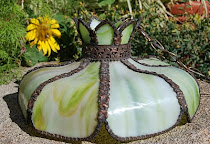
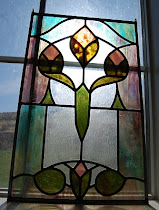
In this method a lead channel is used to hold the pieces of glass together as opposed to strips of copper foil "tape" in the Tiffany or Copper Foil Method. The lead came used is a soft, flexible material that bends easily to the shape of the glass. When seen in cross-section, flat came resembles the letter H laid on its side: It has a vertical crossbar down its middle, with 2 channels on either side. This crossbar, or heart, is approximately 1/16" thick and serves to separate the pieces of glass that are fitted into the channels on either side. The came is cut where it meets another came at intersections in the design. These intersections, called joints, are then soldered, front and back. When viewed a leaded piece appears as shapes of colored glass silhouetted and outlined by the dark came. The process of creating a leaded panel is sometimes referred to as glazing.
Lead Came
Lead is a unique metal: It is extremely soft in its pure form, has little mechanical strength, almost no elasticity, and melts at relatively low temperatures. These properties were probably the reasons early stained glass craftsman selected this it. They could form it into usable strips, it was easily cut, and easy to shape and work with their hands.
Lead is a unique metal: It is extremely soft in its pure form, has little mechanical strength, almost no elasticity, and melts at relatively low temperatures. These properties were probably the reasons early stained glass craftsman selected this it. They could form it into usable strips, it was easily cut, and easy to shape and work with their hands.
Why is it called lead came? The Romans were key in introducing the use of lead throughout Europe and the Mediterranean. They produced lead "came" by laying reeds side by side in a shallow pit. Molten lead was then poured into the pit covering the reeds. Once the lead cooled, it was sliced into strips and the burnt reeds removed leaving a concave channels for the glass. It was called Calamus Plumbum, or Reed Lead. As Roman influence gave way to the Gaels in northern Britain, Calamus shortened to Caim. Later Caim was Anglicized to Came. This was how the channeled lead used in stained glass fabrication became Came Lead or lead came1.
 The lead cames used in stained glass are made by an extrusion process where the molten metal is pressed through a steel die, remember the Play-Doh Fun Factory?It can be pure lead or contain a small percentage of other metal alloys, antimony is one, to toughen or make it bright. You can also find in encased in a brass "skin" or made entirely of other metals such as copper, zinc and brass. Now it is even comes as lead free.
 Lead came: All cames come in 4 basic shapes: round H, round U, flat H, and flat U. There are also specialty cames such as high heart and those with unique profiles like colonial and prairie style. The size if a came refers to the width of the face, regardless of style. 1/4" Flat U and 1/4" round H both are 1/4" wide. The portion that connects the two faces is called the heart and standard width is 1/16" and 5/32" tall. The channel is the portion the glass slides into and it is most often 3/32" deep. Lead is most often purchased in either 6 foot lengths or coiled on spools. Generally H cames are interior leads and U cames are used on the perimeter.
Safety First!
Lead is a potentially hazardous material and certain precautions should be followed to ensure safe handling. Lead and lead oxides are not normally absorbed into the body through unbroken skin. They can enter by ingestion or through an open cut. Detailed information is available from your lead came supplier, in publications from the SGAA but you can start with:
Lead is a potentially hazardous material and certain precautions should be followed to ensure safe handling. Lead and lead oxides are not normally absorbed into the body through unbroken skin. They can enter by ingestion or through an open cut. Detailed information is available from your lead came supplier, in publications from the SGAA but you can start with:
- Always wash your hands thoroughly with soap and water after working with lead.
- Never eat, drink, or smoke while working on your lead came projects. Keep all food and drink out of your work area.
- Always protect open cuts or sores with a bandage.
- Never allow children access to your tools, lead supplies or your glazing work area.
- Pregnant and nursing women must avoid contact with lead products.
In the Tool BoxThere are a few tools you will need unique to leaded glass construction. These are in addition to your basic glass cutting tools.
- A work surface that you can nail into and attached two raised edges (glazing blocks) to.
- Glazing hammer: special hammer with both soft and hard heads.
Lead knife and / or lead nippers: for cutting the lead cames to length.
- Horseshoe or glazing blocks: for holding glass and came in place during construction and soldering.
- Lead pattern shears: These remove the correct amount of space from pattern pieces to account for the thickness the heart takes up.
- Fid: tool used to help fit, position, and seat the glass and lead during construction.

Preparation
Pattern Preparation: You will need to make 3 copies of your pattern. One for reference, one to cut apart with your lead pattern shears and one to assemble on. It is helpful to number and make any notations about color, grain direction on all three copies.
Pattern Preparation: You will need to make 3 copies of your pattern. One for reference, one to cut apart with your lead pattern shears and one to assemble on. It is helpful to number and make any notations about color, grain direction on all three copies.
Work Surface Preparation: Lead panels are built out and down from a staring corner to the opposite corner. First attach two glazing blocks (strips of wood) at right angles to each other onto your work surface. These will give you and edge to work against and help keep your panel square as it is constructed. Place the working copy of your pattern with the bottom and left hand side against these two guides and secure in place. You will build your project on top of the pattern. This way you can check your piece size and lead placement as you go.
Cutting your pieces: Use your lead pattern shears to cut apart pattern piece copy. Use these to layout, score and break out all the glass pieces for your project. Check your piece size and shape by laying the cut pieces onto the assembly pattern. You should be able to see the drawing lines around each piece. Grind or re-cut pieces as needed.
Stretching the LeadLead came needs to be stretched just prior to use. This is done to remove the initial creep that lead will undergo in time and to also stiffens it. (For a more detailed explanation please read the Stretching Leadarticle by G. Copeland). There are several different ways to stretch lead: Two people can hold opposite ends in pliers and pull; you can secure on end in a vice and use pliers to pull the opposite or there are lead pullers. What you are looking for is to pull the lead straight back making sure no to twist or kink it. Initially you will feel some resistance, then the lead will give way and then you will feel resistance again.
Cutting the LeadUsing lead nippers requires just a bit of practice. You will cut across the open channel, not across the face. Cutting down through the face can cause the faces of the came to become smashed and distorted. You want to position the jaws at 90° to the open end of the lead channel, making sure the face of the pliers remains square to the came as you squeeze the handles and cut the lead to length. You don't want to tip forward or away as you cut. This will leave gaps in your lead joints and prevent them from soldering together properly.
You should notice that the side of the came that faced the flat side of the pliers has a nice, straight edge. The opposite edge on the remaining piece will have a pointed edge. This is due to the shape of the nippers. You will need to take your nippers and remove that point so that you have a nice straight edge before cutting it to length for you next piece. You also need to pay attention when cutting your came pieces to length that you are cutting the clean edge on the piece being used for assembly. Practice on some scrap pieces first to get a feel for the nippers and how they work.
AssemblyStart by cutting two pieces of lead for the bottom and left side edges of the panel. Generally U lead is used around the perimeter if the piece is going into a framework of some type. If you plan to free hang it you may want to consider using zinc or another metal U came for added strength. Place these on top of the working drawing, against the stops. Now place that piece of glass that goes into the corner, inserting it into the channels of both sides. You should see the drawing line exposed around the glass piece. If you don't remove the piece and either groze or grind it until it does.
 Now take a piece of H came and measure and cut it to fit onto the exposed glass edge and butt neatly against the leading already in place. The place where two or more pieces of leading meet is the lead joint. Secure in place with a push pin or cushioned horseshoe nail. You will soon be able to gauge how much shorter to cut your lead piece to accommodate the channel overlap of the adjoining lead pieces. There may be places due to the design where the leads don't' meet at a nice right-angles and the leads need to be cut on an angle or miter to fit properly.
You continue building over and up in this manner, inserting the class pieces and fitting and cutting the lead came that surrounds them. This is where a fid and glazing hammer may be useful when helping fit and coax pieces into place. As you move along in the construction, make sure that your pieces are fitting within the lines of the design and you're sufficiently securing the pieces as you work to prevent shifting.
When all the glass pieces and interior leading are completed, use more of the perimeter came to finish the remaining edges and secure the entire panel in place.
Soldering Lead projects are soldered at the places where lead cames meet, the joints. This is different from copper foil where all the seams are soldered together. The soldering tools needed are the same: a chisel tip soldering iron for stained glass, a stained glass solder, flux, and a well ventilated area to solder in. You may find a iron and rheostat combination easier to work. It allows you to control the tip temperature so that you melt the solder and not the lead came. It is a good idea to tip test your iron before soldering. Hold the iron tip against a scrap of lead. You should be hold the iron there for a few seconds without melting the lead came itself. This is where an iron and rheostat combination is handy in helping you dial in the exact right temperature.
Lead projects are soldered at the places where lead cames meet, the joints. This is different from copper foil where all the seams are soldered together. The soldering tools needed are the same: a chisel tip soldering iron for stained glass, a stained glass solder, flux, and a well ventilated area to solder in. You may find a iron and rheostat combination easier to work. It allows you to control the tip temperature so that you melt the solder and not the lead came. It is a good idea to tip test your iron before soldering. Hold the iron tip against a scrap of lead. You should be hold the iron there for a few seconds without melting the lead came itself. This is where an iron and rheostat combination is handy in helping you dial in the exact right temperature. Apply flux to all the lead joints. The goal is to apply flux only to the you want the solder to stick to. A rule of thumb is that the solder extends out from the center of the joint an amount equal to the width of the came face. Place the end of the solder on the joint and touch it with the flat side of the iron tip and allow the solder to melt down onto the joint. At that point move the tip in a small circular motion for just a second then pull (not lift!) the tip away. The solder should flow into a gently rounded bead, extending evenly onto all the cames from the joint center. If the solder is not smooth, place your iron back on the soldered joint and move in a circular motion until it is molten then pull away. You may need to apply a bit of additional flux.
You will solder all the joints on the front of the panel then turn it over and repeat the process on the back. Inspect both sides to make sure you haven't missed any and you have nice, smoothly soldered joints. Clean and then you are ready for cementing, the final step.
Occasionally you may find a your leads don't exactly meet edge to edge and there is a gap. These gaps won't take solder and can prevent proper joining or result in a pinched solder joint. Beginners especially find this when the flip the panel over to solder the back. There is a way to bridge that gap called chinking. Chinking involves taking a small piece of came and cutting it half long-ways, down the center of the heart. You then cut small pieces from one of the halves that will fit into that gap snugly. Flux and solder as outlined above. You can find more information on soldering both lead came and copper foil products online in Inland Crafts' free How to Solder Like a Pro booklet.
CementingThis is the final step in assembly of a leaded glass panel. It helps secure the glass in the came, strengthen, and weatherproofs the piece. Even if you are hanging the piece indoors you need to cement for the added strength it adds to the piece. The process forces the cementing material into the spaces in the channel between the glass and came.
 You will need a cementing product specifically for leaded glass, whiting (or sawdust), two natural bristle brushes and several layers of newspaper to cover your work area. Follow the manufacturers directions for mixing the cement. Pour some cement onto the panel or pick some up on the end of one of the brushes. You want to push the cement up against the lead, forcing the cement under leaves and into the channels, making sure to work against all the faces.
 Once you have worked in the cement, sprinkle the entire panel lightly with whiting. Whiting helps soak up the oils, dry the cement and clean up any excess. Use the second brush to scrub the entire panel surface. Work first in a circular motion, then parallel to the lead came until all excess cement is removed. The whiting will also help burnish and darken the lead while polishing and brightening the glass. The longer you work the whiting, the darker the lead becomes.
 Once the front is cemented and cleaned, turn the panel over onto a clean layer of newspapers and repeat the process on the back side. Leave your panel to lay flat for 24 to 48 hours to allow the cement to set and start curing. Wile drying, you may notice places where the cement has oozed out. Use a pointed wood stick (sharpened dowel, craft stick cut at an angle, fid) to scrape along leads and perimeter of each glass piece to remove. You can find more detailed information on cementing a leaded glass panel online in Inland Crafts' free Cementing "How To" booklet.
Thank you to our friends at Inland for writing this tutorial. http://www.inlandcraft.com/


 Posts
Posts






No comments:
Post a Comment